
...the piano pickup company

the solution for great piano sound!

 Helpinstill Designs 5108 Aspen St. Bellaire TX 77401 713/432-1089
   
Home Products/Prices Company History Why is it so hard to mic a piano? How to Order Recording Tips  User List  Testimonials  Contact Us 

Magnetic Piano & Keyboard Pickups

Products


 Model 120 Helpinstill Grand Piano Sensor

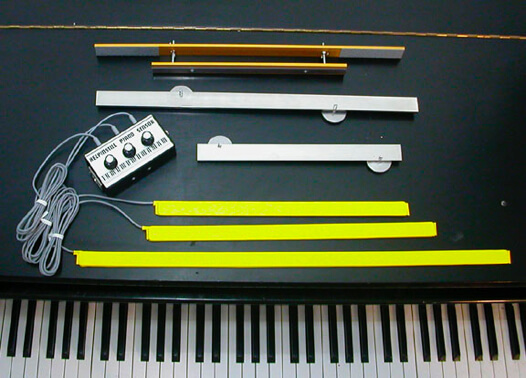
Our basic system for any size Grand Piano. A streamlined, simplified piano pickup that retains the essential features and purity of sound common to all Helpinstills, but takes into account the needs of today's user for a no-maintenance direct feed from the piano. Divides the piano keyboard into three regions to insure uniform volume from every note. Installs in minutes without tools, comes with a 90-day money-back trial guarantee. $550.

Model 180 Noise-Cancelling Design Grand Piano Sensor

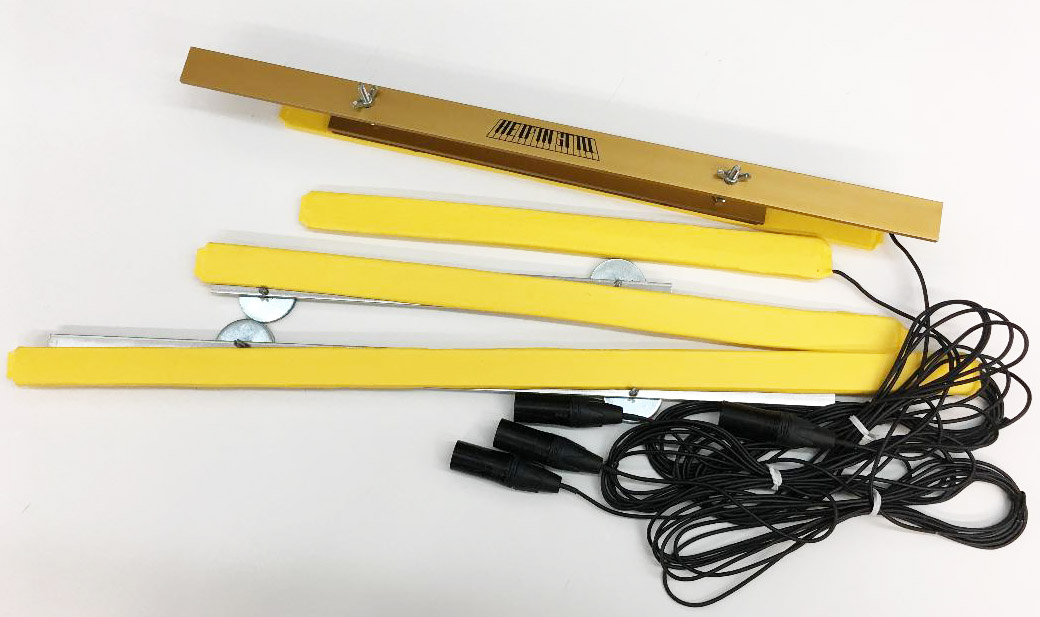
Created for severe environments and touring acts that require the ultimate in performance, the Model 180 is identical to the Model 120 except that the sensor strips are a new double-coil noise-cancelling design similar in principle to humbucking guitar pickups. As effective as the Model 120 has proven to be for almost every application, situations arise where superior signal-to-noise ratios and high rejection of EM field noise in the vicinity of the keyboard pickup are required. This unit is highly recommended for pianos containing built-in electronics of any kind, such as the Yamaha CD-Player models, and MIDI-equipped instruments. Trials in the field with major touring acts Tom Petty and the Heartbreakers and Norah Jones have produced praise not only for the noise-free characteristics, but for the realistic sound as well. $850.

Model 125 Helpinstill Upright Piano Sensor

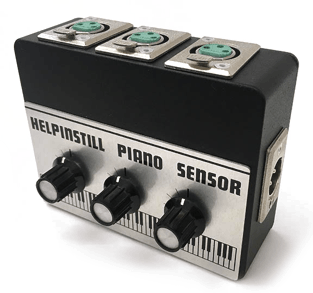
This was actually the first model that used our method of pickup construction that we eventually applied to all our systems. The pickup strips (Sensors) are thin, flexible magnetic strips, allowing them to be slipped in behind the strings, where they automatically stick very strongly to the cast-iron frame of the piano (the "plate") much like refrigerator note-holding magnets. Since all upright pianos have the keyboard range divided into three sections, three sensors provide coverage of every note. We have selected the lengths through years of experience to provide the best chance of complete coverage on whatever piano you might have. Plugging these into the control box then allows for fine-tuning the note volumes, and provides the two types of output connections you might need. The lack of necessity of any brackets or other equipment allows the Model 125 for uprights to be cheaper than the Grand models, but they all work on the same principle. Of course, grand pianos sound different from uprights, and the Piano Sensor reflects that difference, so it can't make an upright sound like a grand, but it can give you a feedback-free connection to a sound system, and with the additional low-end capability, it can come close. A special model is also available for 64-note uprights. $395.

Model 135 Grand & Upright Piano Sensor

Need to be able to handle anything you might run into? This piano hookup is for you! Combines both the Model 120 for Grands and the Model 125 for Uprights with no duplication of parts. Consists of everything in a Model 125 as well as the Model 120 brackets used on Grands and a 24" Sensor element necessary for Grand Piano installations. $670.

 NEW! Model 185 Stereo Grand Piano Sensor

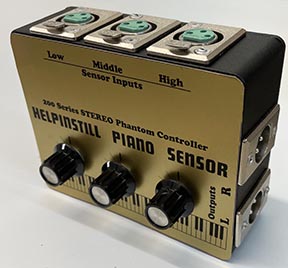
Many of our customers have requested the capability of a stereo output, since they are used to a keyboard microphone array. We had to invent a radical new concept in pickup design to accomplish this, and produce TRUE Stereo imaging. As the chart below shows, this system allows the performer to play up the keyboard while the stereo image smoothly shifts from left to right. The secret lies in the new Crossfade Sensor used in the middle region of the piano, which uses dual coils and varying strength magnetic pickup fields to gradually decrease the output to the Left Channel, while increasing the output to the Right Channel as the notes get higher. The result is a smooth, natural transition from left to right in the pan image, and no discernable jump as the output shifts from one region to the next. The background bleedthrough between the sensors through the wood of the piano (which causes low notes to eventually appear in the high sensor and vice-versa) results in an amazingly realistic stereo image across the pan field similar to results of using a microphone pair on the piano. In addition, the dual-coil sensors used in the low and high regions are wired for the same humbucking effect as the Model 180, for the lowest background hum possible. The Stereo Control Box supplied with the Model 185 looks identical to the Mono version, except it has both XLR and phone jack outputs for both channels, Left and Right. Available on special order for $1250.

  Downloadable Manuals

Model 120 Manual

Model 125 Manual

Model 180 Manual

Model 185 Manual

The Manuals are Adobe Acrobat (.pdf) Files

Windows users- Right-click on the link, then select "Save Link As", and select your desktop.

Mac users- Click and hold or command-click, select "Download Link to Disk."

Install Adobe Reader- It's a free download:
Get Adobe Reader


  Carrying Case

Suitable for carrying any model Helpinstill that needs to be moved from piano to piano. Sturdy black blow-molded plastic case with foam lining fitted to each model. Measures 27" x 17" x 5." $80


  Model 120 Installed


 The control box provides both XLR and phone jack outputs

©2006 Helpinstill